This chapter measures how local labor demand and the outside option available elsewhere shape the internal migration, earnings, and employment of displaced workers. The evidence comes from annual employer–employee administrative data from Canadian tax filings (2001–2019). I look at workers displaced during mass layoffs, and match each displaced worker to an observably similar non-displaced worker. Guided by a discrete-choice model of internal migration, I measure the worker's outside option as a migration-weighted average of economic conditions in other provinces. I find that migration responds to the gap between local and outside economic conditions, and not the levels themselves. A one standard deviation increase in the gap raises the propensity to migrate by 0.2 to 0.4 percentage points depending on the proxy of local labor demand. This effect is large compared to the baseline interprovincial migration rate of around 0.9%. Furthermore, displaced workers respond more than non-displaced workers. Unlike the propensity to migrate, I find that earnings and employment respond mainly to local economic conditions. A one standard deviation increase in local labor demand raises displaced workers' earnings by 6.3–7.3% of pre-displacement earnings, roughly twice the response of non-displaced workers, and raises their probability of employment by 0.8 to 2.3 percentage points, while non-displaced workers' probability of employment is unaffected. Finally, I show that a worker who migrates when labor demand is relatively higher elsewhere is drawn to a destination where short-term economic conditions are also relatively better compared to their origin province.
Olivier Gagnon
PhD Candidate in Economics, McGill University.
On the job market 2025–2026.
My research interests are in labor economics: how job loss affects immigrants, how economic conditions across provinces affect displaced workers’ migration and outcomes, and why STEM graduates work outside their field of study.
Job Market Paper
Are Recent Immigrants More Resilient to Job Loss? Evidence from Mass Layoffs in Canada
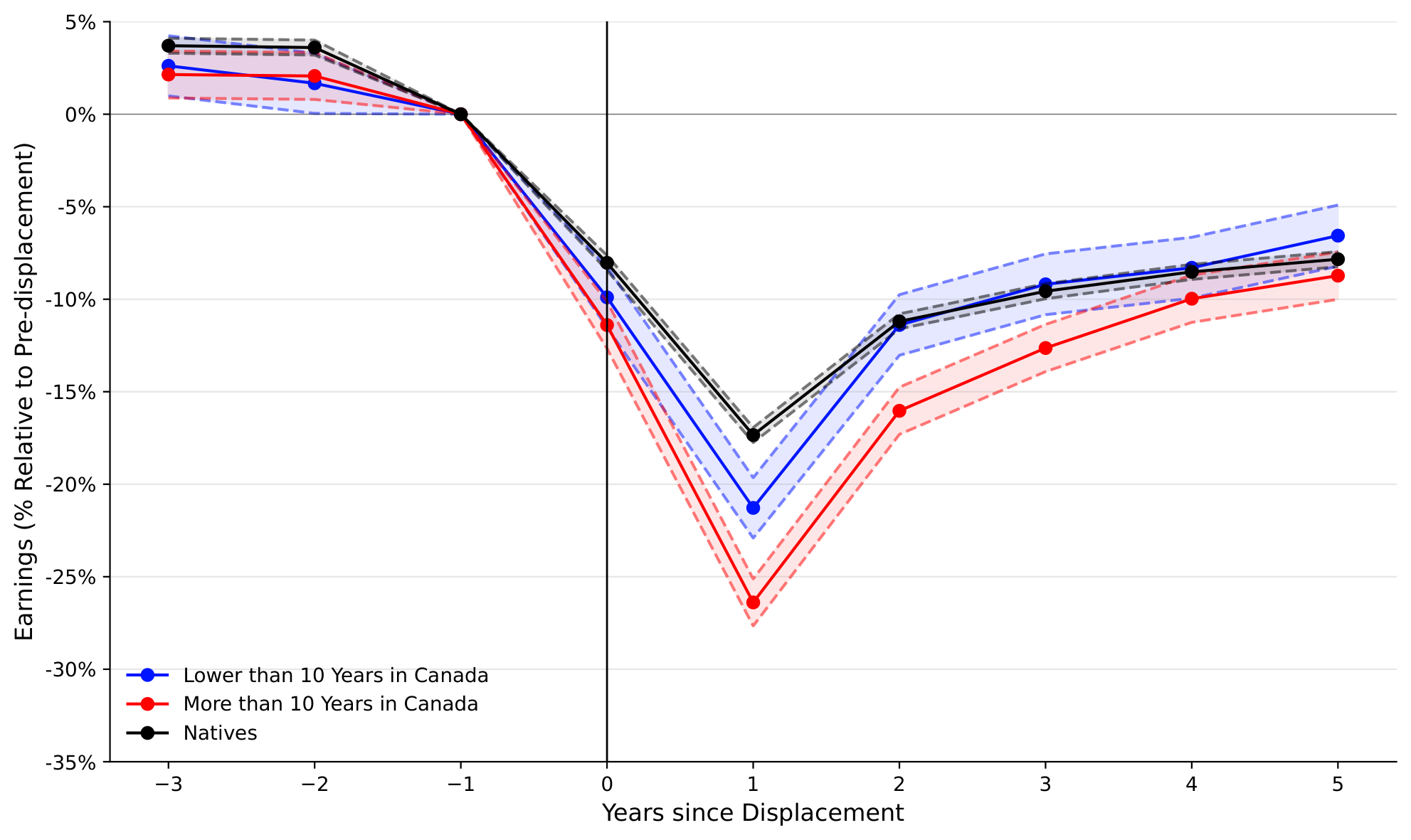
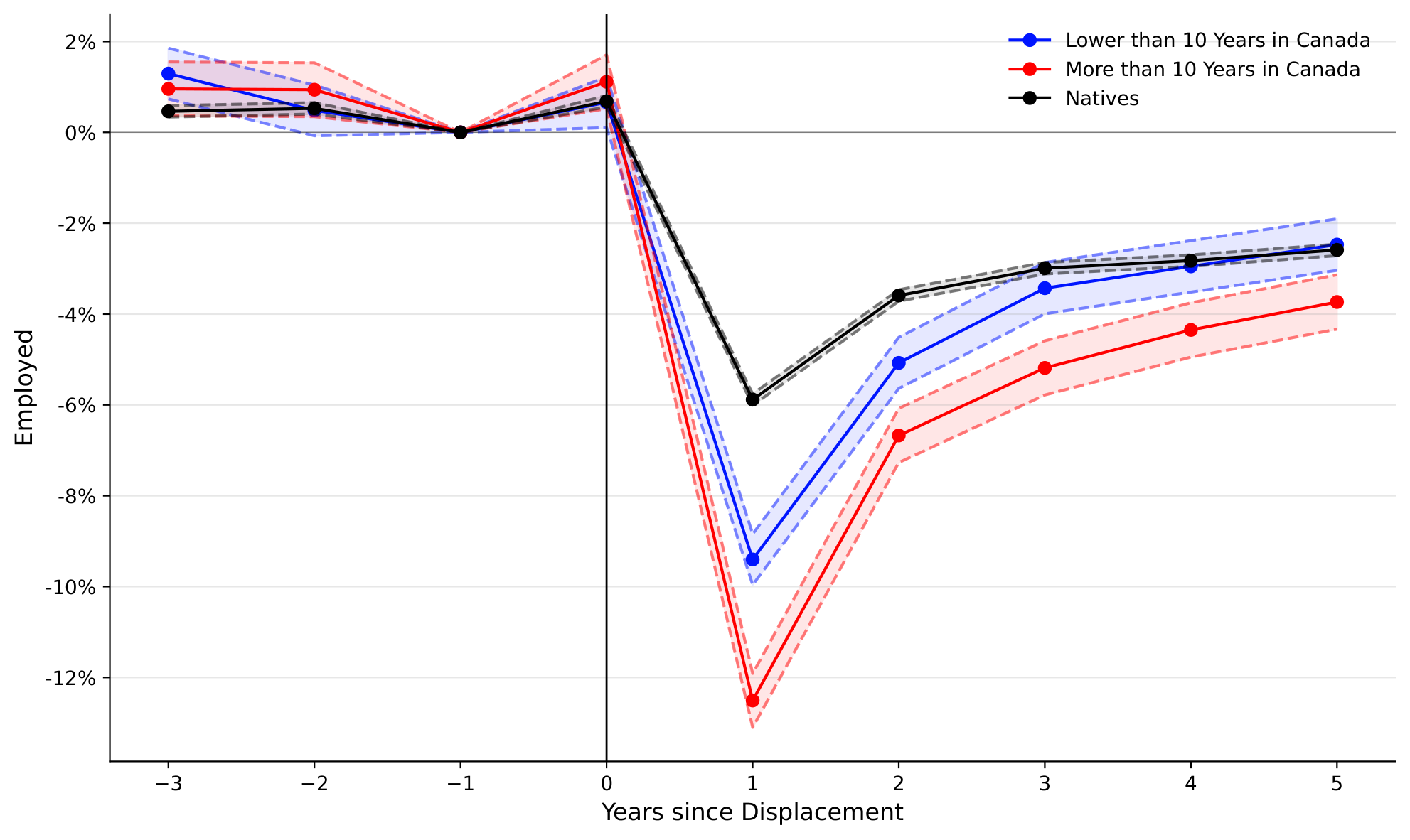
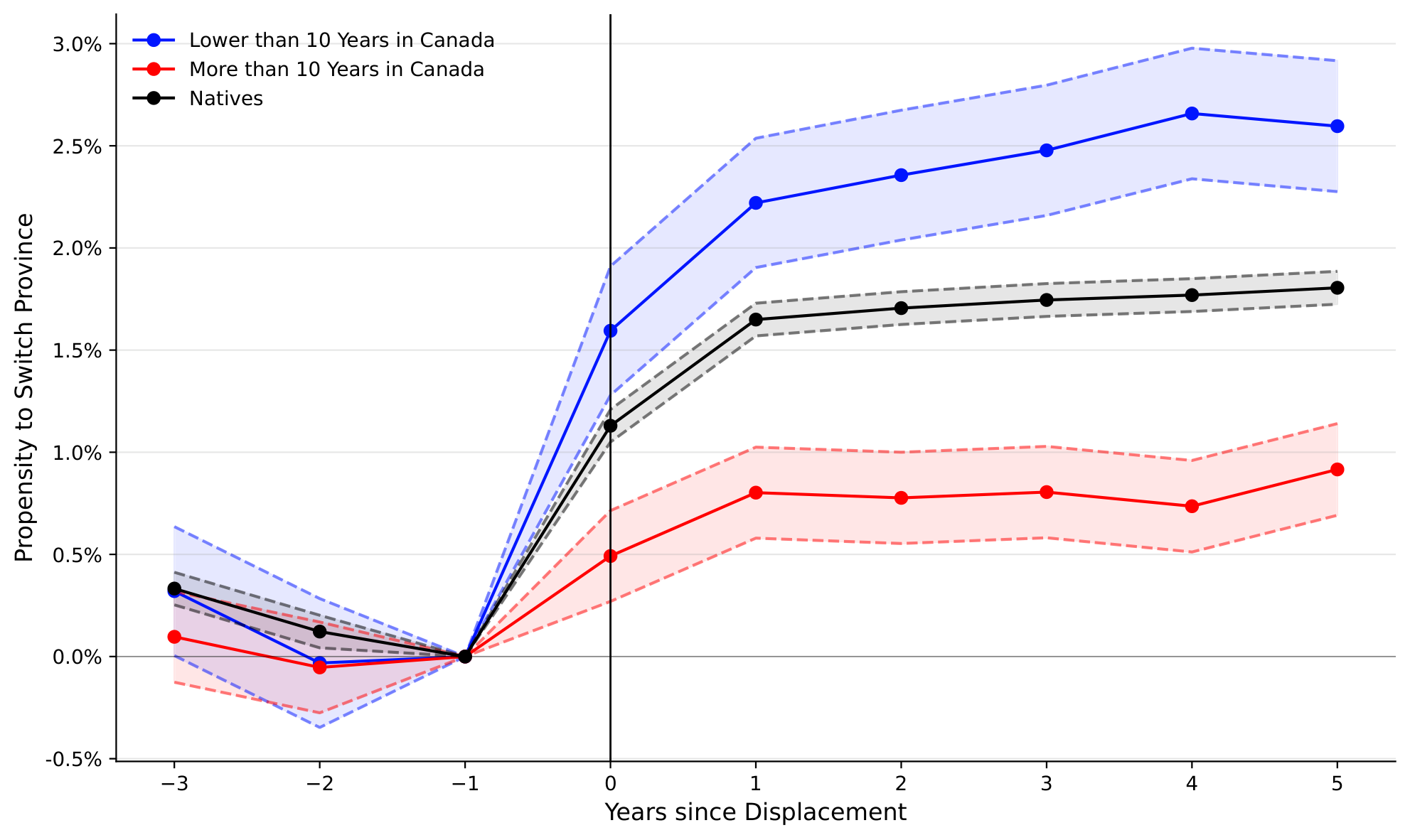
This chapter measures the effect of job loss on the subsequent labor market outcomes of immigrants as a function of the time spent in the host country at the time of displacement. The evidence comes from yearly employer–employee administrative data from Canadian taxes (2001–2019), linked to immigration records. I look at immigrants displaced during mass layoffs, which provide plausibly exogenous job separations. I estimate the impact of displacement in two distinct ways. First, through an event study approach. Second, through a regression-based approach that allows me to quantify how differences in the composition of pre-displacement characteristics contribute to the heterogeneous treatment effects and how the heterogeneity in earnings loss is linked to specific differences in post-displacement outcomes. I find that recent immigrants experience smaller and less persistent earnings losses from displacement, with a 21% decrease in earnings one year after displacement, compared to 26% for those who have been in the host country longer. Recent immigrants also display better post-displacement outcomes in other dimensions, such as lower time spent nonemployed and higher geographic mobility. I show that differences in pre-displacement characteristics account for 50% of the heterogeneous treatment effects on earnings: each additional year in Canada results in 0.8 percentage points larger earnings losses, but only 0.4 percentage points when controlling for pre-displacement characteristics. Age at displacement alone explains half of this difference. Differences in post-displacement outcomes account for an additional 40% of the heterogeneity in earnings losses, with time spent nonemployed being the most important mechanism.
Other Research in Progress
Moving After Job Loss: Local Demand, Outside Options, and the Migration of Displaced Workers
What Can We Learn from Switching Behaviors? Preference Shocks and the Roy Model